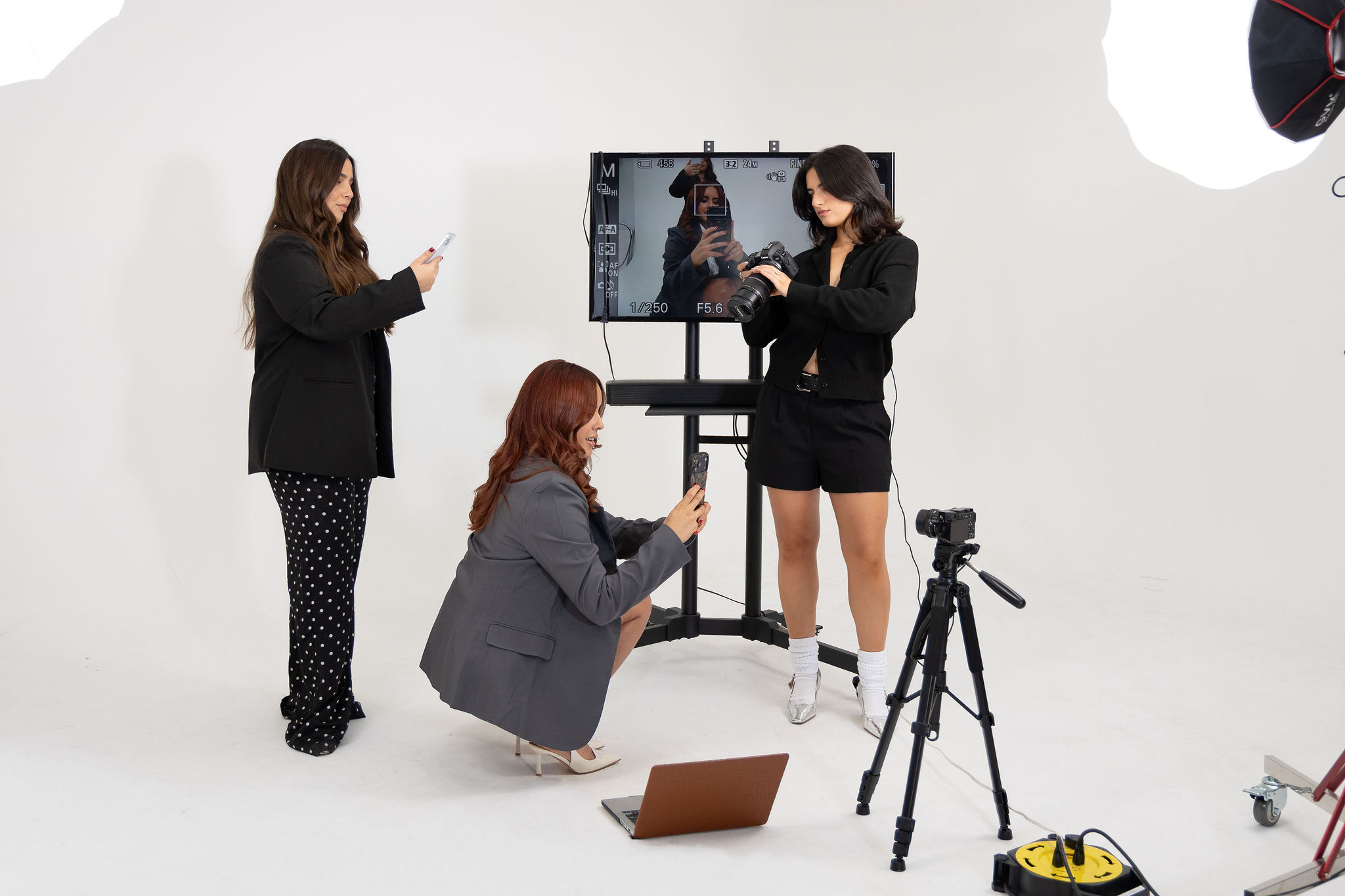
What Is a Cyclorama Wall?
A cyclorama wall, also called a cyc wall or infinity wall, is a curved studio wall that bends smoothly into the floor with no visible corner. That curve removes the horizon line, so the background reads as one continuous, edgeless surface on camera. It is the standard backdrop for fashion, product, video, and any shoot that needs a clean, controlled background with nothing to crop around.
Shoot on the cyclorama
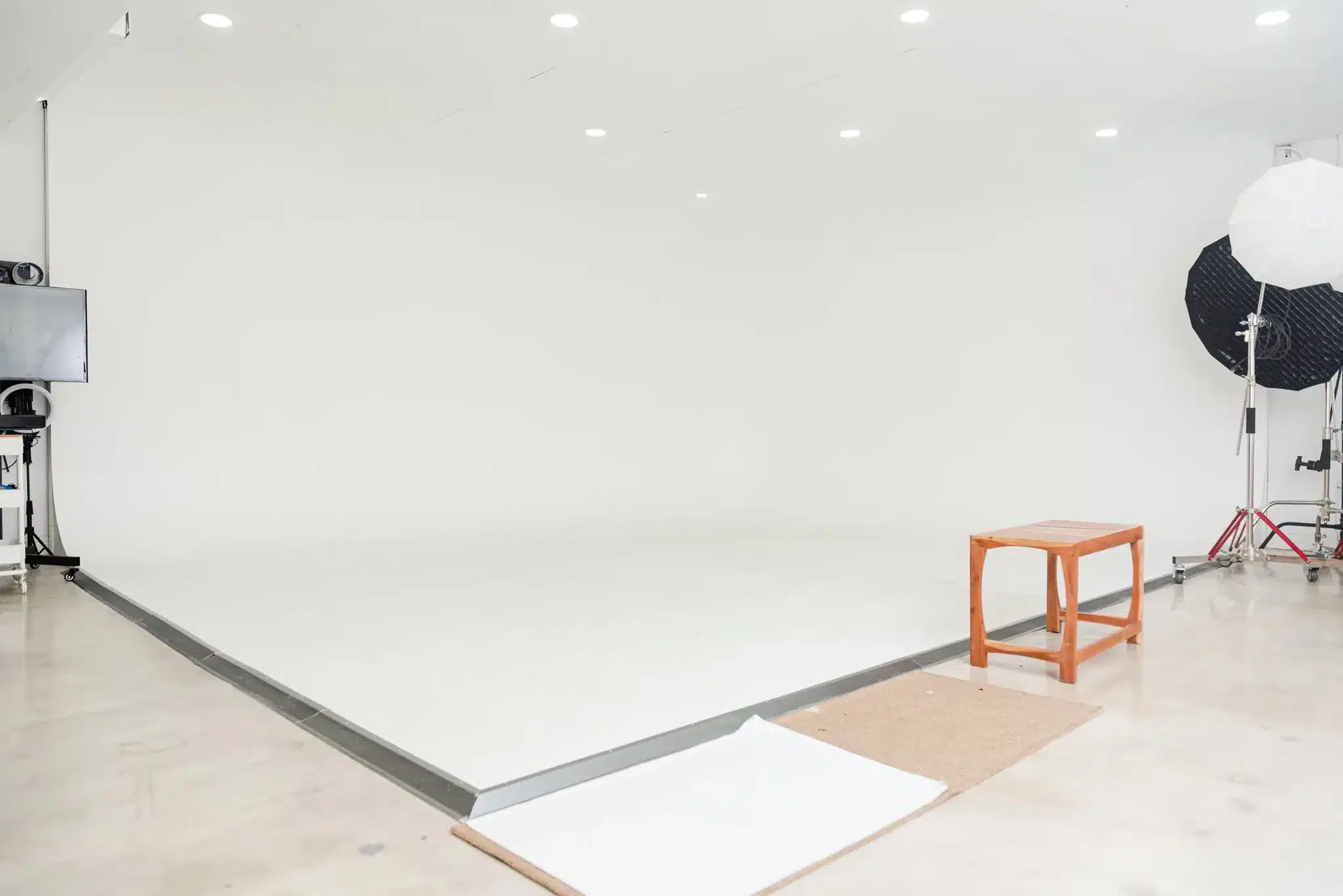
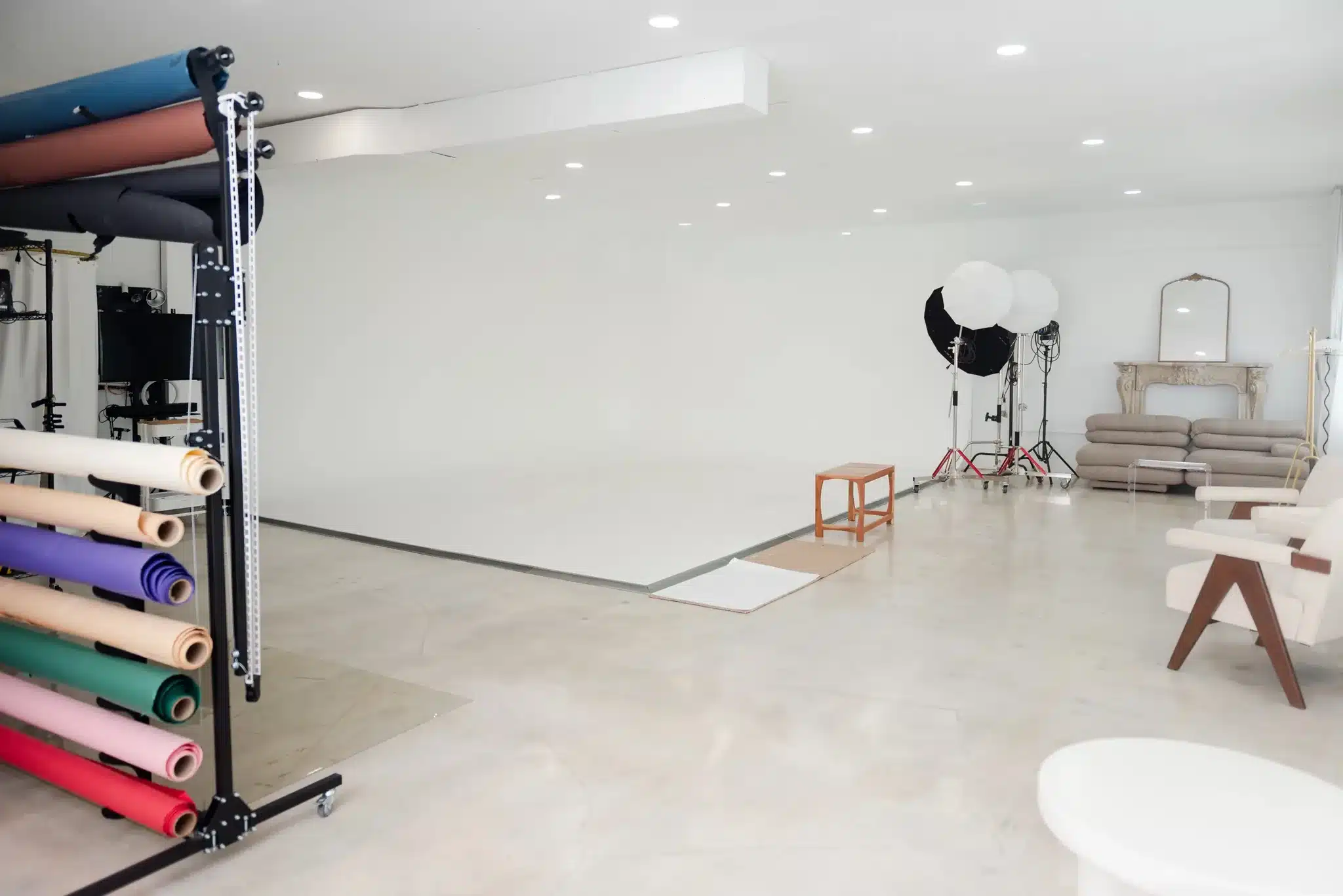
Ours is 25 by 20 feet, and it is included in every studio booking along with the lighting, all eight sets and the props library.
Building a cyc wall rather than booking one? This guide covers how they are made, but CC Studios rents its cyclorama — we do not build them for other spaces. See full rates.
The curve is the whole point. A flat white wall meets the floor at a hard corner, and that corner catches a shadow line the camera sees. A cyclorama hides that line behind a gentle cove, which is why the background can look like it goes on forever. That is also why a cyc is not the same as a roll of paper or a painted wall, and why studios build them into the room rather than rig them up for a day.
Key takeaways
- A cyclorama wall, cyc wall, and infinity wall are three names for the same thing: a curved, seamless wall-to-floor surface with no visible corner.
- The curve removes the horizon line, so the background looks infinite and needs little to no cleanup in post.
- You light the wall separately from your subject. The wall does not turn white on its own.
- A cyclorama is an in-camera background. A green screen is for compositing a digital background later. They solve different problems.
- Width, ceiling height, and depth all matter. Most private cyc walls in Miami run under 12 feet wide. The one at our studio is 25 feet wide and 20 feet tall.
- You do not have to build one. You can rent a real cyclorama wall by the hour in Miami from $110.
Where the name comes from
The word comes from the theater. A cyclorama was a large curved backdrop at the back of a stage, used to suggest an open sky or a distant landscape. The name joins two Greek roots, kyklos for circle and orama for view. Film and photography borrowed the idea and the name, then shortened it on set to cyc. You can read the theatrical history of the cyclorama if you want the full background, but the short version is simple: a curved surface that hides its own edges.
How a cyclorama wall is built, and why the curve matters
The curved part where the wall meets the floor is called the cove. The radius of that cove decides how far back your camera can sit before the floor line creeps into the frame. A wider radius gives a softer transition and a longer working distance. A shadow that would pool in a sharp corner has nothing to grab onto on a true cove, which is what gives you that clean, edgeless look.
There are two broad types. A hard cyc is permanent, usually built from concrete and plaster and finished in matte white paint. It is durable, holds its shape exactly, and can be repainted between shoots, so people and rolling gear and even furniture can sit on the cove without hurting the surface. A soft cyc is a fabric or vinyl system stretched on a frame. It approximates the curve but can wrinkle under load and tends to show seams at close range. Our studio is a hard, built-in cyclorama, which is why it holds up to full production days.
Size also depends on how it is made. Small studios drop in a prefabricated curved corner, often 8 to 12 feet wide. Anything wider is usually custom built for the room, because the wall, the ceiling height, and the floor all have to be designed around it. A 25 foot wide cyc needs a purpose-built room, which is part of why large ones are uncommon.

Cyclorama wall vs seamless paper vs green screen
People searching for a cyc are often weighing it against two cheaper options. Here is the honest comparison.
| Option | Best for | The catch |
|---|---|---|
| Cyclorama wall | Clean white or colored backgrounds, full-body work, video, anything where the floor is in the shot | Permanent, so you rent studio time rather than own it |
| Seamless paper | Quick, portable, low-budget setups in a small space | The floor join is a fold, not a curve, so it shows at low angles. It wrinkles, tears, and marks |
| Green screen | Replacing the background with a digital scene that does not physically exist | Has to be keyed in post, and green spill on hair and skin is a common headache |
The key difference between a cyclorama and a green screen confuses people the most. A white cyc is an in-camera background. What you see in the viewfinder is what you get, with no editing of the background. A green screen is a compositing tool. The green is removed later and a digital scene takes its place. Same curved wall can do both, since a cyc can be painted green, but the jobs are different. Choose a white cyc when the clean background is the final look. Choose green screen when you are dropping in a world that is not really there.
What size cyclorama wall do you need?
Width gets all the attention, but height and depth matter just as much. A tall ceiling lets the camera pull back for a full-length figure on a normal lens without distortion, and it keeps overhead lighting and rigging out of frame. Depth, the room to pull your subject well off the wall, is what lets you blur the background and light the subject separately. A shallow cyc forces everyone forward and flattens the result.
| What you are shooting | Width that works |
|---|---|
| Solo portrait, headshots, small product | 8 to 12 ft |
| Two people, small fashion looks | 12 to 16 ft |
| Full-body fashion, groups, dance, video, large product | 16 to 25 ft and up |
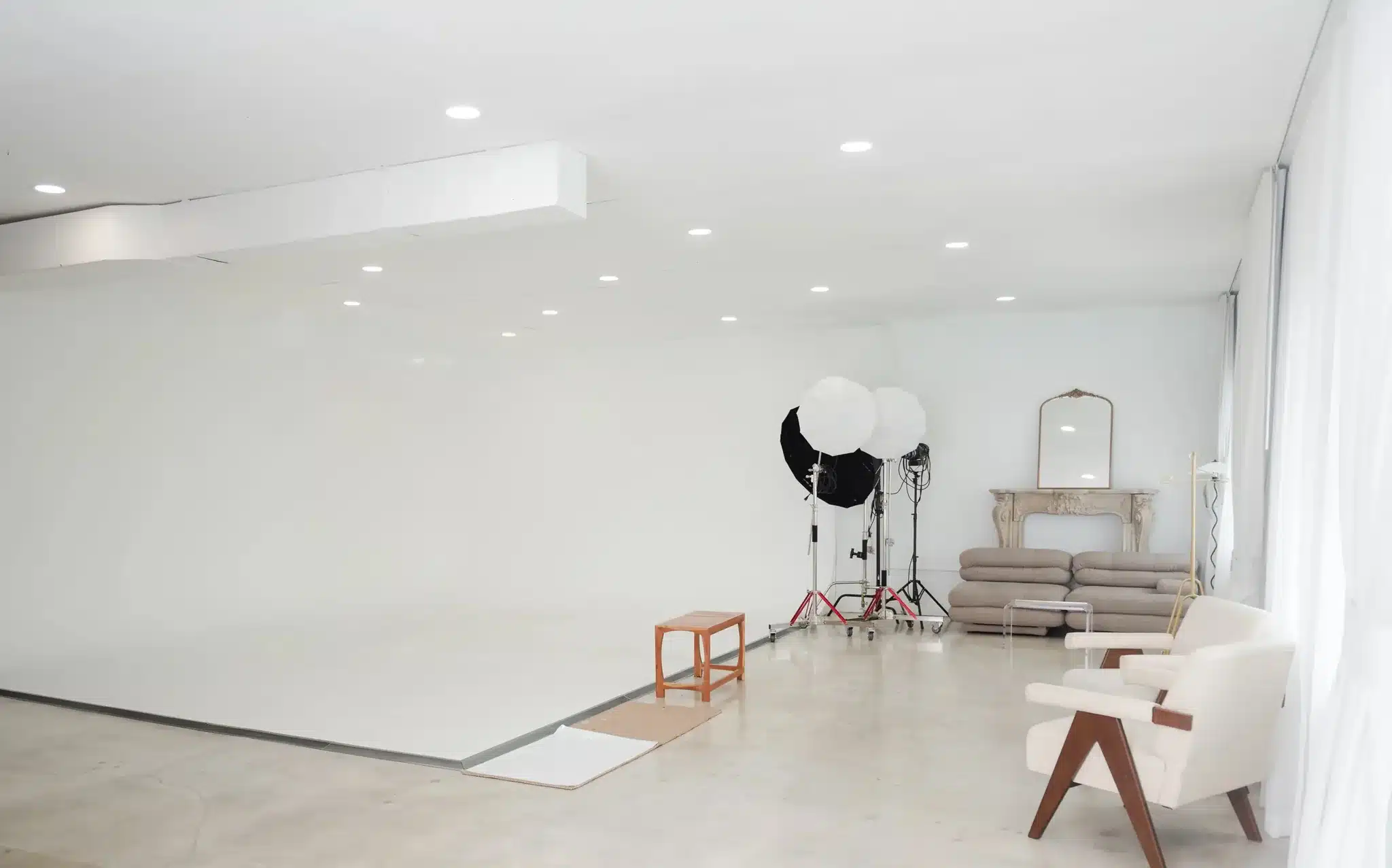
This is where the honest local picture matters. Most private rental studios in Miami that list a cyclorama are working with a cove under 12 feet wide. At that width, a full-length standing figure with lights inside the cove and any real camera distance will find the edges. Our wall is 25 feet wide and 20 feet tall, which is wide enough for a full production crew to set up inside the cove and still have room to move.
How to light a cyclorama wall
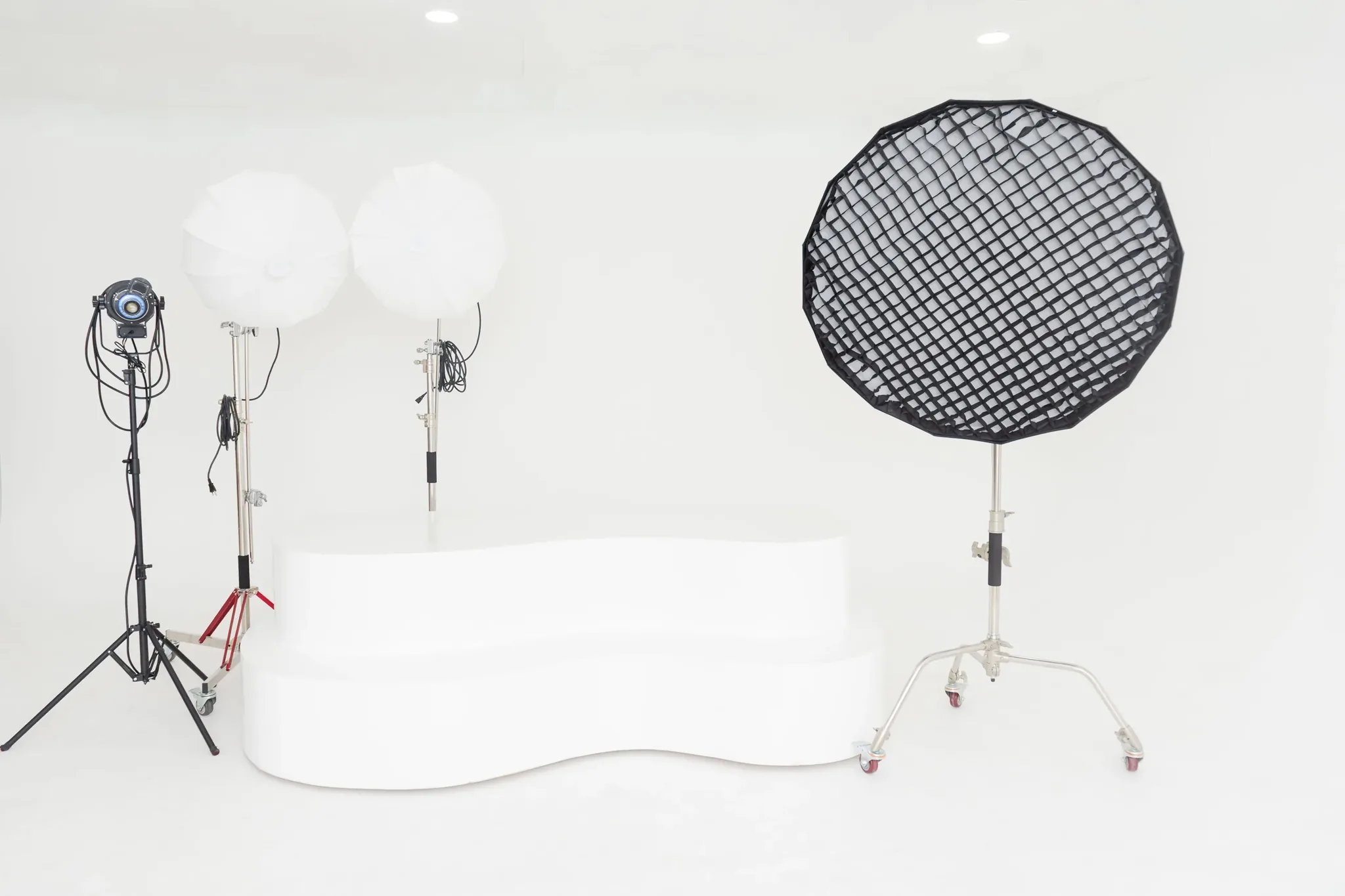
The most common surprise for first-timers is that the wall does not make a white background by itself. Unlit, a matte white cyc photographs as flat gray. You build the white with light, and you light the wall separately from your subject. Our studio includes the gear to do all of this: two Godox SK400II-V strobes, a Profoto kit, three GVM 150W continuous LEDs, and GVM 1200D RGB panels for color.
Pure white, for product and headshots
Light the wall with two soft sources, one on each side, aimed to wash the surface evenly. Add a low source at the base of the cove so the curve does not fall into shadow. Then light your subject on its own. The simple rule for a clean white is to keep the background roughly one to one and a half stops brighter than your subject. Push it much past that and the spill starts to wrap around your subject and eat detail at the edges.
Soft gray to deep shadow, for editorial
For a moodier look, do the opposite. Light the subject with a single key, then turn the wall lights down or off. With distance and control, the same white cyc reads as soft gray or near black, so you get a dark-field background without hanging a separate backdrop.
Color, for music videos and brand content
Because the surface is neutral matte white, it takes color cleanly from a light source. RGB panels can wash the full wall in any single color or blend two hues across its width. A tinted wall would fight the color you are adding, which is exactly why a true cyc is painted neutral white.
The two mistakes to avoid
First, an under-lit cove. If the base of the curve goes dark, you lose the seamless effect, so give the floor-to-wall transition its own light. Second, a bare, hard light aimed straight at the wall, which leaves a bright hot spot behind your subject. Keep the wall lights diffused through softboxes or panels and the surface stays even.
What you can shoot on a cyclorama wall
The short answer is most things that need a clean, controlled background. The longer answer is worth a look, because the reasons differ by shoot.

Fashion and editorial. The seamless background keeps the focus on the clothes and the figure. With real width you can shoot full-length looks on a normal lens, capture movement, and leave negative space to crop into later.
Music videos and performance. Performance needs room to move and a camera that can track without hitting a wall. A wide cyc plus color washes gives an artist a clean stage that can change mood between takes. This is a real and growing use in Miami's Latin music and hip-hop scene.
Product and e-commerce. A pure white cyc removes background cleanup from your retouching, which adds up fast across a large catalog. The floor is part of the surface, so flat lays and standing products both sit on seamless white.
Headshots and personal branding. A clean, neutral background is still the standard for professional headshots, and it does not date the way a styled set can. The width fits a full team in one frame for a corporate headshot day.
Dance, fitness, and movement. Jumps, extensions, and action need open floor with nothing to trip the shot. The cove gives clean, uninterrupted space, and even side and top light freezes motion without color casts.
Video and commercial work. Single or multi-camera, interview setups with a colored wall behind the subject, talking-head brand videos, scripted spots. A high ceiling means rigging stays out of frame. See real examples in the studio gallery.
What a cyclorama wall is not the best tool for
An honest answer helps you book the right thing. A cyc is not your tool when you want a textured or architectural background, a real environment as part of the story, or a hard, dramatic shadow falling onto a wall as a creative choice. It is also not the move for a lifestyle scene that needs furniture and a built set. For those, a styled set serves you better, and our studio has six of them alongside the cyc. Pick the cyclorama when the background should disappear, and a set when the background is part of the picture.
Should you build one or rent one?
If you have shot on a cyc, the building urge is understandable. The math is usually the problem. A real hard cyc means plywood and plaster or block, a properly radiused cove, enough width and ceiling height, paint, and the space to give it up full time, plus repainting upkeep. That is a serious build and a permanent piece of your floor. Unless you are shooting on it constantly, booking an hour when you actually have a shoot beats carpentry, cleanup, and maintenance. You get a perfect wall, lit and ready, with none of the overhead.
Renting a cyclorama wall in Miami
If you want to shoot on one, you can book a real, built-in hard cyclorama by the hour. Ours is 25 feet wide and 20 feet tall, one of the largest private cyc walls in Miami, set inside a fully private 3,000 sq ft studio in Glenvar Heights, central Miami-Dade. It is about 8 minutes from Coral Gables, 12 from Brickell, and 18 from Wynwood, with free on-site parking, easy ground-floor load-in, and 24/7 access. Studio rental starts at $110 per hour on weekdays, and professional lighting is included. You can see full pricing and live availability on the cyclorama wall rental page, or take a virtual tour of the space first.
Two ways to use it. Rent the studio and bring your own photographer or crew, or book a Photoshoot Package from $350 and our in-house photographer plans and shoots the session for you. If you need a green screen, the wall can be painted green or another color for chroma key work, so reach out before booking and we will prep the color. The studio also serves clients across every Miami neighborhood, from Coral Gables and South Miami to Wynwood and Miami Beach.
Frequently asked questions
What does "cyc" stand for?
Cyc is just short for cyclorama, the term set crews use day to day. The word comes from the theater and joins the Greek roots kyklos, meaning circle, and orama, meaning view. It describes the curved surface that hides its own edges.
Why is the corner of a cyclorama curved instead of square?
A square corner where the wall meets the floor catches a visible shadow line. The curve, called the cove, removes that line so the floor and wall read as one continuous surface. That is what creates the infinite-background effect on camera.
What is the difference between a cyclorama wall and seamless paper?
A cyclorama is a permanent curved structure, so the floor-to-wall transition is a real curve. Seamless paper is a flat roll, so its floor join is a fold that shows at low angles or full-body distances, and the paper wrinkles, tears, and marks. The cyc holds up to footsteps, props, and heavy use that would destroy paper.
What size cyclorama do I need for fashion photography?
For full-body and multi-model fashion, look for 16 feet of width or more, with a tall ceiling so you can shoot full-length on a normal lens. Under about 12 feet, a standing figure plus side lighting tends to find the edges of the cove. Our wall is 25 by 20 feet for exactly this reason.
How do you get a pure white background on a cyclorama?
Light the wall separately from your subject, using soft sources on each side and a light at the base of the cove so the curve stays even. Keep the background roughly one to one and a half stops brighter than the subject. The wall does not turn white on its own, it photographs gray until you light it.
How far should the subject stand from the cyclorama wall?
Enough distance to light the subject without spilling onto the wall, and to blur the background if you want separation, usually several feet. More depth gives you more control. A shallow setup forces the subject close to the wall and flattens the look, which is why room depth matters as much as width.
Cyclorama wall or green screen, which should I use?
Use a white cyclorama when the clean background is the final look, like product, fashion, headshots, and most video. Use a green screen when you are compositing a digital environment that does not exist in the room. A cyc needs no keying in post, while a green screen does and can spill green onto your subject. The same wall can be painted green when you need chroma key.
Can you shoot video on a cyclorama wall?
Yes. A cyc is a standard video background for interviews, commercials, music videos, and brand content. A wide wall lets the camera move and gives performers room, and color panels can wash the wall to match a look. A high ceiling keeps rigging out of frame.
Where can I rent a cyclorama wall in Miami?
You can rent our 25 by 20 foot cyclorama by the hour at Creative Canvas Photo Studio Miami in Glenvar Heights, central to Coral Gables, Brickell, and Wynwood, with free parking and 24/7 access. Rates start at $110 per hour on weekdays. See full details on the cyclorama wall rental page.
Book the cyclorama wall
Now you know what a cyclorama wall is, how it works, and what it can do. The simple part: you do not have to build one. Check availability and book, or compare every option on the rates page. Free parking, pro lighting included, open 24 hours.
Book Your Studio Session
Rent the private 3,000 sq ft studio and its 25x20 cyclorama wall from $110/hr, or book a Photoshoot Package and our in-house photographer shoots it for you, from $350. Free parking, open 24/7, central to every Miami neighborhood.